
Solana is becoming one of the leading blockchains for real-world crypto payments. Fast transactions, low fees, and simple payment tools make it easier for businesses to accept crypto.
This guide explains how Solana payments work, what happens after a customer clicks Pay, how transactions are confirmed, and how businesses can start accepting crypto payments.
What Are Solana Payments?
Solana payments are a simple way to send and receive crypto on the Solana network. They include direct wallet transfers, payments with SOL, USDC or USDT and solutions like Solana Pay and CryptoNow built for businesses.
- Speed: Transactions usually confirm in less than 1 second, making payments feel fast and smooth for users.
- Low fees: With fees around $0.00025, businesses can accept small payments, subscriptions, and everyday transactions without high costs.
- Ecosystem: A large developer community and many ready-to-use tools help businesses build and integrate crypto payments.
For businesses, it means customers can pay directly from their wallets, while payments are processed quickly and with very low fees.
What Happens During a Payment?
Customer chooses the payment method SOL, USDC, or USDT and confirms the transaction in their wallet. The wallet then creates the transaction and sends it to the Solana blockchain.
Inside the blockchain, every transaction contains instructions. They tell Solana what actions to take. A simple payment can have one instruction, like sending 1 SOL from one wallet to another. But a transaction can include multiple instructions, allowing funds to be sent to different wallets at the same time.
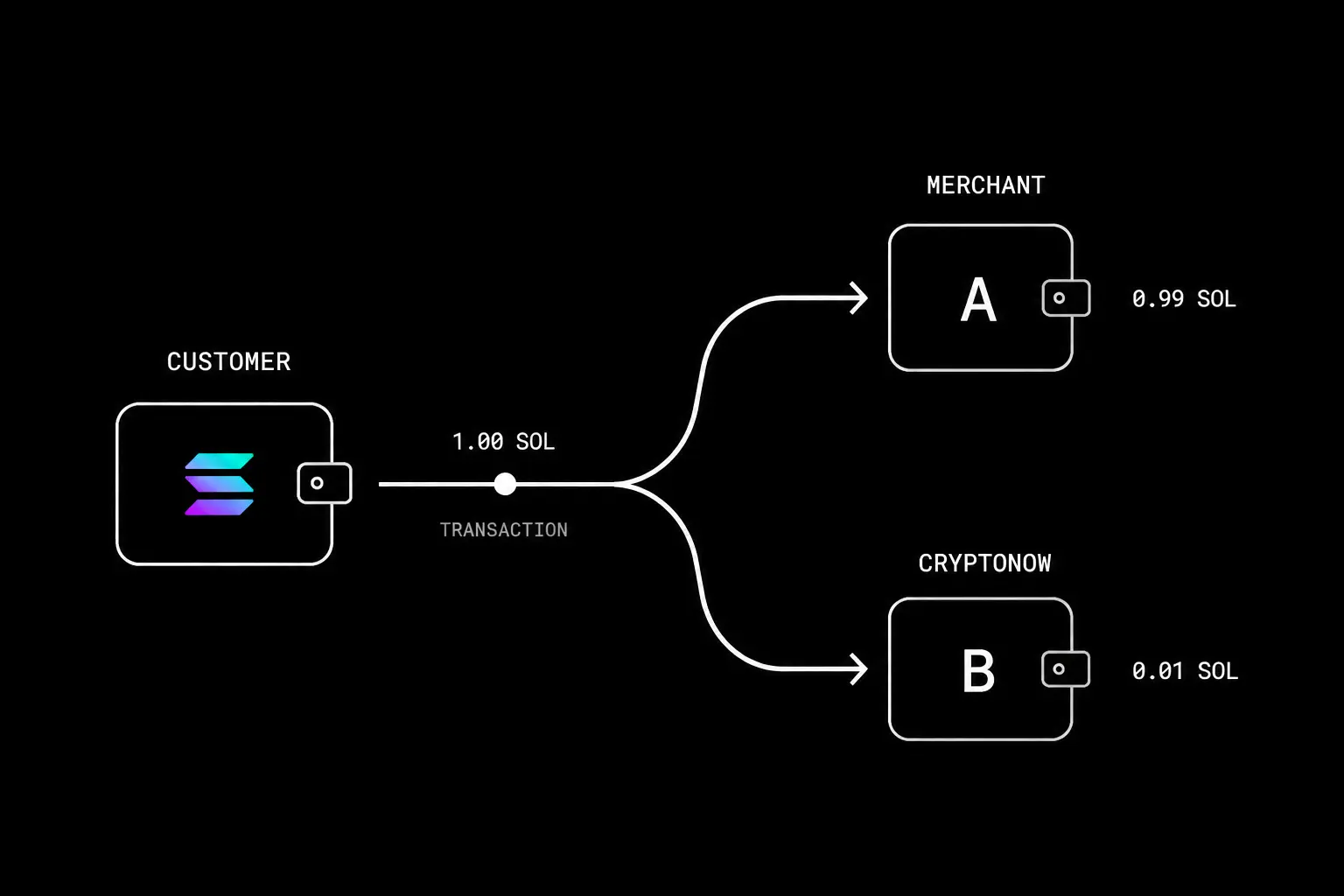
For example, a customer sends 0.99 SOL to the merchant wallet and 0.01 SOL to the platform wallet. Crypto payment solutions like CryptoNow use this method to take a small fee from each payment while keeping the payment process fully Non-Custodial.
How Do I Know a Payment Is Complete?
There are 3 common ways to check if a Solana payment was completed:
- Directly use Solana RPC to ask the blockchain for the transaction status.
- Use node providers like Helius that provide tools for tracking blockchain activity.
- Use a crypto payment gateway and receive a webhook notification on your server after the payment is confirmed.
If you build your own payment infrastructure, you can use Solana RPC or node providers to track payments yourself. With a payment solution like CryptoNow, you do not need to monitor the blockchain manually. Our system handles confirmation and sends a webhook directly to your backend.
After your backend knows that the payment is successful, you can mark the order as paid in your system — then process it however you want, your customer can receive a digital product or service.
Ways to Accept Solana Payments
Feature | Solana Pay or RPC | Custodial Gateway Example (MoonPay) | Non-Custodial (CryptoNow) |
|---|---|---|---|
Full control over funds | ✅ | ❌ | ✅ |
Without KYC | ✅ | ❌ | ✅ |
Setup time | High | Low | Low |
Fees | Near-zero | 1%-2% | 0.5%-1% |
Best for | Developers building their own payment infrastructure | Businesses | Most businesses |
There is no single way to accept crypto payments. The right choice depends on how much control, development work, and simplicity your business needs.
Solana Pay or RPC: Building your own payment infrastructure gives you full control, but you need to handle address generation, transaction tracking, validation, WebSocket, and other payment logic yourself. For stable performance, businesses often use node providers like Helius, QuickNode, or Alchemy. The result is a fully independent payment system where you control the infrastructure and funds go directly to your wallet.
Custodial gateways (MoonPay): Integration is much easier because everything works through APIs and webhooks. You do not need to build payment infrastructure from scratch. The downside is that funds are handled by a third party, and you usually need to complete KYC verification.
Non-custodial gateways: This is the easiest way to start accepting crypto payments. You simply create an account, integrate the API and Webhooks, and payments go directly to your own wallet. No KYC, no third party holding your funds.
Conclusion
There is no one best way to accept crypto payments. It all depends on your business needs. If you want to accept SOL and USDC with a non-custodial gateway, CryptoNow lets you start with a simple API integration. Our getting started guide walks you through the setup process in under five minutes.